3/30/2022

Monthly Roundup - What I'm reading, watching and listening to: March Edition

Books: The Fellowship of the Ring: The Lord of the Rings Part One - J.R.R Tolkien

I've read The Hobbit a few times but have yet to read the Lord of the Rings trilogy. I've read about 150 pages of The Fellowship. Tolkien is an expert storyteller who takes his time spinning this tale into an epic of modern literature. In his foreword, Tolkien writes that he didn’t draw on current events or life experiences while writing the books and that the story has no meaning or explanation in the present. Rather, he wanted to try his hand at writing a long story, which he has done masterfully, through his words, songs, languages, and drawings.

Music: Road to Knowhere, Tommy Guerrero.

Though I discovered Road to Knowhere a few years ago, I finally downloaded the album and have had it on repeat this month. Tommy Guerrero, legendary California skateboarder, has recorded several albums featuring his genre-bending guitar playing. The album is comprised of guitar-driven instrumentals and blends latin, african, jazz, funk and surf music. Road to Knowhere evokes road trips along dusty desert highways to forgotten places with Guerrero's guitar guiding us on our journey.

Movies: The Rum Diary

“I wanna make a promise to you, the reader. And I don’t know if I can fulfill it tomorrow, or the day after that. But I put the bastards of the world at notice: that I do not have their best interests at heart. I will try to speak for my reader. That is my promise. And it will be a voice made of ink and rage.

While looking through papers in writer Hunter S. Thompson's home, actor Johnny Depp discovered Thompson's manuscript for The Rum Diary and helped to get the novel published and adapted into a film. Largely autobiographical of Thompson's time in Puerto Rico, Depp plays failed novelist Paul Kemp who gets a job working for the local newspaper San Juan Star. As Kemp explores the island in a series of alcoholic adventures, he gets caught up with businessman Sanderson who tries to lure Kemp into his plan to turn a beautiful island into a tourist hellhole. Kemp's boss wants him to play by the rules while Sanderson wants Kemp to publish fiction as fact about his development plans. Kemp learns by the end of the film that he must use his voice to keep the 'bastards of the world' in line. I enjoyed the film and I look forward to reading the book.

Podcasts: SYSK Operation Northwoods episode

Josh and Chuck from Stuff You Should Know always find a way to break the tension and inject some quirky humor into their episodes, even into topics as diabolical as the hare-brained schemes of the United States government. In 1962, with tensions growing between the U.S. and Cuba's communist government under Fidel Castro, the Joint Chiefs of Staff proposed Operation Northwoods- a false flag operation designed to justify U.S. military intervention in Cuba. Ultimately rejected by President John F. Kennedy, Jr., Operation Northwoods included plans to target Cubans traveling to Florida, to sabotaging/destroying U.S. ships in Guantanamo Bay to staging mock attacks on U.S. fighter planes. Tensions increased in October 1962 with the Cuban Missile Crisis and covert operations in Cuba ceased thereafter. This podcast is an interesting insight into the dark annals of American history during the Cold War.


Til next time,
KW

3/09/2022

Typewriter Updates

Testing the machine post-clean.
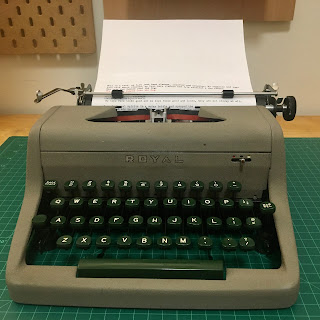
I recently did some maintenance on my 1957 Royal Companion typewriter. I had a few sticky keys and needed to install a new ribbon. I'd like to share how I fixed these issues. I'll include some videos I found helpful in the Links section below.

Since I picked up the typewriter, several keys had become pretty sticky. My first step was to clean the segment. I picked up a bottle of mineral spirits, a spray bottle, a nylon brush and microfiber towels. It's important to use a product like mineral spirits or denatured alcohol when cleaning your typewriter as any product containing water may cause rust- and NEVER use WD40. I put a towel underneath the type bars and on any other surface I wanted to protect from the mineral spirits. I sprayed the mineral spirits into the segment, removing the excess with a towel or compressed air. I used the small nylon brush to work the mineral spirits into the segment and onto the typebars, then worked it in further by hitting each key several times to clear out any dirt and grime in the segment. I repeated this process of spraying mineral spirits and hitting each key until there were no more sticky keys. I also cleaned the typefaces by applying mineral spirits and cleaning each face with the brush. I repeated this until the typefaces were free of built-up ink.

To clean the exterior of the typewriter, I used some Simple Green. I tested it first to make sure it was safe to use. I tried to scrub out the marks and spots, but some marks were harder to remove than others. I will have to repeat this process again. I also cleaned the keys themselves.

Once I was done cleaning the interior and exterior, my last step was to install a new ribbon. The ribbon which came with the typewriter may have been the original! It was in sorry shape with many holes, tears, and creases. I bought these ribbons and attached the new ribbon onto the original spool which came with the typewriter. I've read that it's important to use the original spools, if you have them, as these can differ from machine to machine. The ribbons, however, are pretty standard at a half-inch wide. I removed the old ribbon from the spool and then attached the new ribbon to the original spool. To wind the new ribbon onto the original spool, I used the typewriter itself by turning the spool until the entire ribbon was on one spool and then attached the other end to the second spool. Overall this process was pretty simple.  Note: gloves are recommended when changing ribbons.

So - I solved the sticky keys issue and the new ribbon types well. My typewriter types and feels like a new machine. In the future I may take it apart to really get into the areas I can't otherwise reach as there is still some residual dirt and dust.


KW

Links
Fixing stuck keys with mineral spirits
Another video on cleaning the segment (any video from Phoenix Typewriter is helpful)
This video was helpful regarding ribbons & spools

3/07/2022

First Hike of the Year

Trail sign denoting distance to nearby landmarks.

Over the weekend, my brother Eric and I went for a hike in Harriman State Park. The park is about a 1.5 hour drive from my Brooklyn apartment and offers well maintained trails, sweeping views of the Hudson River valley, and glimpses into the area's past. I've been hiking in Harriman and the surrounding area for over 15 years and still enjoy visiting.

We parked at Anthony Wayne Recreation Area and headed south on a bike trail which intersected with the Appalachian Trail (AT). The AT is a 2,194 mile long trail which stretches across 14 states from Maine to Georgia. The trail traverses Harriman and Bear Mountain State Parks as it winds through New York. We followed the AT and ascended a ridge to the east of the parking lot. From this ridge, we could see the undulating hills and ridges of the western Harriman region and beyond. We continued north along the ridge and descended from it's east side, the Perkins Memorial Tower atop Bear Mountain visible in the distance. 

Perkins Memorial Tower, Bear Mountain

As we descended, Eric slipped on ice and fell. We'd been hiking for about an hour and realized that many sections of trail were still covered in ice which made ascending and descending slow and tricky. Fortunately, Eric had the foresight to bring two pairs of microspikes- steel spikes on a harness which can be worn over any shoe. Unfortunately, we only put them on after he fell but luckily he was unharmed. Wearing the microspikes, we were able to easily navigate up and down these icy trail sections.

The trail descended into a valley. We weren't far from Doodletown, an abandoned town which existed in the shadow of Bear Mountain since the 18th century. During the mid-1960s, Doodletown was ultimately abandoned due to land disputes with NY State. Visitors to the state parks can see the remaining stone foundations of Doodletown homes and two cemeteries. During the Revolutionary War, the British army landed at Stony Point and marched to Doodletown where they split up before heading towards the American forces at forts Clinton and Montgomery, located within today's Bear Mountain State Park. The British path is denoted by the 1777 and 1779 trails.

We followed a yellow-blazed trail south towards West Mountain, our lunch break destination. The trail up the ridge was a long climb, and as is characteristic of the area, there were many 'false' summits. We held a steady pace and kept hiking. A particularly steep, rocky section - which would have been difficult were we not using our microspikes - was the final push towards the top of the ridge. At a trail junction we headed east for a few hundred yards and reached the West Mountain hiker's shelter.

The shelter faces south giving hikers staying the night or those passing through an unhindered 180 degree view of the Hudson River. The Timp, another rocky peak, sits nearby. On a clear day, the New York City skyline is visible on the horizon. On this day, we could barely make out the skyscrapers due to hazy and cloudy conditions. We had our lunches as we took in the view. A nearby couple, perhaps staying the night, cooked a meal on an open fire. A man hiked by with his companion: a large, fluffy white dog who came over to inspect our food. I snapped a few photos of the view before we headed back.

South facing view from West Mountain

It took us just over an hour to get back to the parking lot from West Mountain. We followed a blue & yellow-blazed trail back to the first ridge we climbed, then continued along the section of the AT we had hiked earlier. As we passed through a group of pine trees, rays of sun passed through the clouds, the first direct sunlight all day. We got back to my car 4.5 hours after we'd begun our hike and covered about 7.5 miles.

Our route from Anthony Wayne to West Mtn.

KW

2/21/2022

2.21.22

In this week's dispatch - Russia/Ukraine, a walk across the Williamsburg Bridge, and a bit about my novel writing process.

Over the past week I have been following the developments in the conflict between Russian and Ukraine. I intended to write on this topic but I am reluctant to share yet - there is still so much to learn. I've realized this conflict has been evolving throughout my entire lifetime (I was born in 1989) and I am only now interested and learning more about it.

In addition to reading articles and reports about the conflict, I have been watching Oliver Stone's The Putin Interviews. Recorded between 2015 and 2017, the series offers President Putin's first full-length interview with a western filmmaker. We see Putin share his thoughts on global issues, including Ukraine, Crimea, and NATO, as well as training Judo and playing hockey. His statements on the U.S. and its role in the world are particularly interesting.

In other news, I walked over the Williamsburg bridge on Saturday. I took the J from Bushwick and as the train crossed the bridge, there was a winter squall occurring. Furious flurries and strong winds, with near white-out conditions, covered the Williamsburg and East River area. When I exited at the Delancey-Essex stop, the weather was warm and sunny again. I walked to SoHo to run some errands and then walked back to Brooklyn over the bridge. The sun was warm, with temperatures in the 40s; I walked with my coat opened. When I made my way down to Domino Park, clouds had rolled in and the cold winds picked up. The wind was powerful - I could lean into it with my arms out and let it hold me up. I walked to Bedford and took the L back to Bushwick.

Earlier in the week, I printed out the approximately 60 pages of a fictional novel I'm writing. Over the past year, I've been writing in the morning by setting a timer and just trying to follow the characters, letting the story unveil itself to me. I had a basic idea of what I wanted to write about but no outline or plot ideas. Now after writing for a while, I've come to a crossroads where I feel its time to try to connect the threads by creating an outline. There are scenes which I like and others which fall flat. As I continue, each scene will have to be fleshed out more because I've just been getting the story out - I still don't know the entire story.

Working on this piece is a fun and exciting process. I experiment with different things and try to push the writing forward. When I first started writing, I struggled with dialogue because I haven't written a fictional work before. Even if the piece doesn’t pan out into a novel, I'm still learning.

Until next week,
KW

2/13/2022

Monthly Roundup - What I'm reading, watching and listening to: February Edition

Books: A Tree Grows in Brooklyn by Betty Smith 
Since roughly the beginning of the year, I've been reading 'A Tree Grows in Brooklyn'. I'm enjoying it but I've been reading slowly, usually before bed. Written in 1943 by Betty Smith, the story chronicles the life of young Francie Nolan who comes of age in Williamsburg, Brooklyn in the 1910s and 20s. Smith is an incredible story teller. Each chapter is a scene, a story on it's own, which transports the reader back to that time period. We get a look into the poor, mostly immigrant community of Williamsburg and the trials and tribulations of the Nolan family as Francie grows up. Having lived in Williamsburg and now in Bushwick, it's interesting to see some familiar streets mentioned in the book as I can compare today's Brooklyn to Smith's Brooklyn. I'm about two-thirds finished with the book. I'm interested to see how it ends, but it's taken me on such a journey that I don't want it too end too soon.

Music: Stephane Wrembel's Django Experiment; Lettuce Elevate
I've been hooked on the music of Stephane Wrembel lately, a French guitarist who plays the 'gypsy jazz' music of Django Reinhardt. I learned about Wrembel from the movie Midnight in Paris, which features his song 'Bistro Fada'. I downloaded a few of his Django Experiment albums which features songs done in the traditional style of jazz in the '20s while other songs have more of a modern interpretation. This style of music really resonates with me lately. I especially enjoyed this online performance as well.

Lettuce has been one of my favorite bands for many years and they continue to play and write music which hooks me. Every time I see them live, the band is better than the last time I saw them. I've been listening to their 2019 album Elevate lately but their live shows are especially captivating - I found this show from 2017 and it's full of the raging funk one can expect from Lettuce.

TV: The Gilded Age
I don’t watch much TV. I don’t have any streaming subscriptions. In fact, I don’t even own a TV. But occasionally a series will capture my attention. I'm a big fan of Downton Abbey and writer/director/producer Julian Fellowes has a new show on HBO. The Gilded Age is set in New York City in the late 19th century. Mostly I'm interested in the history of the era, when rich, powerful families like the Astors, Rockefellers and Vanderbilts, shaped the city and country as we know it. Some historic Gilded age mansions still exist in Manhattan today. There's only three episodes of the show available but its kept me watching so far.

Podcasts: Tanis
Ok I confess - I'm obsessed with Tanis. I wrote a bit about Rabbits, the new novel from writer/producer Terry Miles, but I haven't done a deep dive into Tanis yet (coming soon). This is the third time I'm listening to the podcast. Each time, I discover new tidbits, things I didn't pick up on the first or second listen. The subject matter is what really hooks me- a mysterious place in the woods of the Pacific Northwest where strange things occur. It's not clear who or what this place is but protagonist Nic Silver (Terry Miles) wants to find out. Equal parts conspiracy, historical, spiritual and technological, Tanis has it all for me: the story, the writing, the acting and the sound design is really well done. It's my favorite fictional podcast out there. I usually listen during work when I need to get some mindless task done like inputting data to an Excel sheet. I can just zone out and listen to Nic, MK and the gang delve deeper into the mystery. Recently, I downloaded Season 1 and listened to a few hours while on a road trip - it felt more like how a book unfolds, instead of just tuning-in to an episode here and there. I'm currently working my way through Season 2.

Movies: Encounters at the End of the World; Stalker. 
It's winter here in New York. I find the snow and cold comforting - the city is quieter, the pace is slower. One cold night, I put on Werner Herzog's 2007 film Encounters at the End of the World. Herzog travels to Antarctica to investigate the continent and the collection of people stationed there. As Herzog says, "Antarctica is not the moon, even though sometimes it feels like it."

In the podcast Tanis, Nic Silver mentions the Strugastky brothers sci-fi novel The Roadside Picnic and Andrei Tarkovsky's 1979 film Stalker, also written by the Strugatsky brothers. As I continue down the Tanis rabbit hole, I had to watch Stalker. I can see how the movie influenced Terry Miles while writing and creating Tanis, as the podcast draws heavily on Stalker. On the face, the movie is about a Stalker, a guide, who brings a Writer and a Professor into The Zone, a mysterious place full of traps but where there is a Room which can make your deepest desires come true. It's an interesting film and unlike anything I've ever seen. It's hard to explain, hard to follow at times and I'm not sure what it's really about but I loved it regardless. 

2/06/2022

On journaling and other writing.

Writing helps me focus. By journaling in the morning, I can 'download' my thoughts, feelings and observations to the page, clearing my head while getting my brain working creatively. There's no form, just a few paragraphs on what's going on and what I'm thinking. I don't judge what I've written; I just write. This clears the way for more creative work. Here is a brief description of my journaling and writing habits. 
 
Journals
I wake up between 6 and 630am. I have a glass of water, wash my face, brush my teeth and do some stretching. Next, I perform several rounds of breathing exercise per the Wim Hof method, followed by meditation. Then, I grab a cup of coffee and begin writing.

In a daily planner, I record a brief description of the previous day's events and metrics including: wake and sleep times, meals ate, and miles walked. Recording these details lets me look back on what the day was like and what I accomplished.

In another notebook, I make a journal entry everyday (well, almost everyday). Usually I'll write about what happened the previous day. Journaling lets me write about anything and everything, in no particular order. I can get whatever's floating around in my mind onto the page. This is a great morning practice because I can exercise my brain by focusing on the writing. Last year, I journaled everyday for 80 days which solidified journaling as part of my morning routine. After journaling I will work on a blog post (as I am doing now) or another creative writing project. 

Notebooks
While watching or listening to something throughout the day, I will jot down details in another notebook (I have lots of notebooks). I do this for later reference but also because note-taking helps to remember details. Sometimes these notes become a blog post or another piece of writing. Browsing through my notebook, I see notes on various topics strewn about; they include my interests at that particular time, my observations, and my thoughts.

Typewriting
Since picking up a typewriter last week, I've been experimenting with different styles of writing. Sometimes I'll write a journal-style piece or a creative-nonfiction essay. Last week, I took a scene from a fictional novel I'm writing and tried it out on the typewriter. As an exercise, I re-wrote the screen from memory to see how it would come out. With the typewriter, I'm learning not to 'micro-edit'. When I write on the computer, I'll immediately edit what I wrote instead of getting it down as it comes and editing later, like I do with the typewriter. Plus, the typewriter is just fun to use.

Whether using a pencil in a journal, blogging on my laptop, or using a typewriter, writing helps me focus. It lets me spit out all my thoughts and organize them. I enjoy the editing process, where random sentences can come together into a cohesive piece. Even if I don't work on a project, I'm still glad I journaled that day. I will always find the time and place to write. When I'm writing, I'm only focused on what's in front of me.

KW

P.S. See below for scans of my first draft of this post. 


1/29/2022

Typewriters

I picked up a typewriter this week. I think the idea of writing on one has long been in my subconscious but lately it had floated to the front of my brain. These machines began to call out to me. I knew I needed to get my hands on one and just try it out.

First, there were all those writer bio-documentaries I watched (post coming soon) in which Ellison, Salinger and Thompson sat poised at their typewriters. It worked for them, so maybe it would work for me.

Then there was The Spirited Man video A Computer Supplement, in which Van gives several reasons for using a typewriter. He discusses it's practicality but also it's more esoteric uses. When using a typewriter, you can sit down, free from all the distractions a computer has, and just start typing. You don't have to plug it in, turn it on, or click 'Save' when you get up and leave. The typewriter allows you to write without easily editing and deleting and, as Van says, this captures your voice. This was the video which made me realize: 'hey wait - I can use a typewriter'.

One quiet Sunday morning, I watched the documentary California Typewriter which features the story of a Berklee, typewriter shop. Tom Hanks, John Mayer, David McCullough, Sam Shepard and others, describe the ways they use and enjoy their typewriters. The film also gave the history of the machine, dating back to 1869 when Christopher L. Sholes created the first commercially successful design and the QWERTY keyboard. This documentary was an interesting insight into the cultural significance of the typewriter and a look into it's possible future in our technologically advanced society.

Last weekend, I finally got to try one out. I tested my Grandpa's IBM Model II electric typewriter which was sitting in the basement unused for years. I plugged it in and to my surprise, it functioned well. The key action seemed similar to that of a computer and would allow for fast typing. Given all the moving parts and things that could go wrong with an electric typewriter, I knew I wanted to start with a manual.

This past Monday, I went out for a walk on my lunch break. I passed a local vintage shop and noticed a black Royal in the window. I went in and took a look at it. The price was more than I was I willing to pay so I asked the salesperson if she had any more. She led me towards the back of the store where a grey Royal with green keys sat inside a tweed case. It spoke to me as soon as I saw it. The salesperson placed it on a desk and I tested it out, pressing each key, checking the carriage movement and inspecting it's condition - I learned all I know about how typewriters function from watching Youtube videos. The machine functioned well and was in good condition aside from a few scratches and dust. I'm not an expert or a collector, so maybe I overpaid for it, but I am now the proud owner of a 1957 Royal Companion.

What do I hope to use this machine for? What do I hope to accomplish with it? These are some questions I thought about once I became interested in typewriters.

I think the typewriter will be a creative tool. Perhaps it will let me get ideas down in a different way. I've been typing short essays each day and I can already see how it may change the style or rhythm of my writing. I'm not so much concerned with perfect typing or formatting right now - I can do this on the computer. The typewriter will force me to work on my spelling and grammar. Even typing this paragraph, I have made several edits to spellings and sentence structure that I couldn't have made if I were typewriting. When I write on the computer, I typically print and proofread what I've written. I love that on a typewriter I can instantly look at the words on the page and make notes in the margins or other edits. I also like the sound it makes, my fingers hitting the keys and slamming my words onto the page. It reminds me of playing a musical instrument.

So - here's to my 'new' typewriter. I hope it will be a faithful companion on my writing journey.

1/21/2022

A Dispatch on The French Dispatch

Wes Anderson's most recent film The French Dispatch (2021) chronicles the writing, editing and publication of the final edition of a fictional American magazine following the death of it's founder and editor Arthur Howitzer, Jr. (Bill Murray). All the trademark visual aspects of Anderson's movies are present but as I became immersed in the movie's three unrelated stories, presented in magazine form, I realized that this was a movie about writers and writing. If you are at all interested in the movie, I highly recommend it.

This week I read an article from the Brooklyn Rail on the movie and was delighted to see that someone had written about the movie's writing and it's writers. I did some more research.

I was interested to learn that Anderson wanted to make a film about a magazine and his main inspiration was The New Yorker. I found a segment from The New Yorker's Radio Hour podcast in which Anderson describes his love of the magazine and classic essays from it's team of expatriate writers. Also interviewed in the podcast is actor Jeffrey Wright, who plays Roebuck Wright, a writer loosely based on a combination of James Baldwin, A.J. Liebling and Tennessee Williams. A second Radio Hour segment includes several actors from The French Dispatch reading classic essays from The New Yorker.

Here's a list of pieces which Anderson describes as influences for the film and characters:
  • James Baldwin - Equal in Paris
  • Mavis Gallant - The Events in May: A Paris Notebook I and II
  • S.N Behrman - Duveen (novel mentioned by Anderson at the NY Film Festival by longtime New Yorker writer S.N. Behrman)

I saw The French Dispatch when it opened in theaters and watched it again recently at home. The film envelopes me in the fictional city Ennui, France, and I become captivated by the storytelling and the writers themselves. I love seeing the writers discussing their pieces, researching, typing, taking notes. Occasionally we see into the editing process or the life of the writer. Frances McDormands character, influenced by Mavis Gallant, and Jeffrey Wright's character are particularly compelling. The movie creates a place and a time which I can't get enough of this week.
KW

1/17/2022

Five books read in 2021

In December 2020, I posted a list of ten albums that I listened to over the course of the year. I wanted to post something similar for 2021. Each year, I keep a list of the books I've read and jot down some notes after I've finished. I try to get a sense of the writing style of the author, the storytelling, the plot, what the book made me think or feel, and which lines stuck with me.


As I reviewed this list, rereading my notes, I realized that I've learned a lot about reading and writing over the past year. Books enrich my life. When I get into a book, I really get into it, and if it's something I really like, I can become addicted.  I love how a good book becomes a part of my life - when I can't put it down and I want to keep reading throughout the day. Sometimes, though, I'm not sure if I like a book until I've read about 100 pages. Also, I learn best from reading and even better from writing.


Here are five of the books I read last year (full list at the bottom) and some thoughts on each.
  • The Curse of Lono - Hunter S. Thompson
  • Hiroshima - John Hersey
  • Bird by Bird - Anne Lamott
  • To Be Heard - Roof Alexander
  • Rabbits - Terry Miles

The Curse of Lono - Hunter S. Thompson (1983)

“Yesterday's weirdness is tomorrow's reason why.”

Gonzo-journalist and writer Hunter S. Thompson teams up with old friend and illustrator Ralph Steadman for a series of misadventures in Hawaii while on assignment covering a running marathon. The Curse of Lono is gonzo at its best - exciting, funny, maddening, and dangerous. The book is a thrilling adventure, the words flying off the page and simmering with politics, religion, culture, drugs and alcohol. Despite this, the book is not as well-known or popular as Thompson's other books including Fear and Loathing in Las Vegas. Interwoven with text from historical accounts of Hawaii, The Curse of Lono takes us on a journey through Hawaii's past, present and future as only the inimitable Dr. Thompson can.

Hiroshima - John Hersey (1946)

“At exactly fifteen minutes past eight in the morning, on August 6, 1945, Japanese time . . . the moment when the atomic bomb flashed over Hiroshima . . . "

When the U.S. B-29 bomber Enola Gay dropped the first atomic bomb used during war on the Japanese city of Hiroshima, 100,000 people died instantly. Hiroshima follows six people who survived. Originally written in 1946, Hersey added a post-script in 1985, detailing the past 40 years of the survivors' lives. Hersey shows us the horrific effects of the bomb on the city and its occupants. We are given a view into the lives of the survivors and how they dealt with the aftermath. Hersey travelled to Japan one year after the event to report the facts about the bomb which were unknown to the American and Japanese public. The U.S. government controlled the bomb site and information about the attack [more on this here]. Hiroshima is a stark reminder of the consequences of nuclear war.


Bird by Bird - Anne Lamott (1994)

"…we may notice amazing details during the course of a day but rarely let ourselves stop and really pay attention.  An author makes you notice, makes you pay attention, and this is a great gift. "

Anne Lamott brings her experience as both a writer and teacher in Bird by Bird. She has no doubt seen many writers face the same obstacles and mistakes time and time again. Lamott offers quirky and humorous ramblings which encourage and enlighten aspiring writers every step of the way. Lamott tells us not to worry about "shitty first drafts" and just to take it "bird by bird" or, one short assignment at a time. Bird by Bird is an essential read for new writers or anyone looking to relax, to stop taking themselves so seriously and just write.

To Be Heard: A Story about Williamsburg Brooklyn - Roof Alexander (2012)

"We all shared a feeling of hunger, empty bellies, bottomless appetites that when filled, kept us up at night. When we spoke we shouted, all our voices together, a chorus of pleas and protests, rooftop dreams, voices carrying from building to building, no sky scrapers to block them, we all shared a voice, devouring the ears that accepted it, that opened to us. We would be heard. We would dizzily take in those sunrise nights and talk about what it would be like to be heard."

The year was 2006, before everyone dressed like a 'hipster' and Williamsburg became a destination. To Be Heard is a fictional novel which follows four artists living in the Brooklyn neighborhood, struggling to find their voices. Alexander romanticizes this early era of Williamsburg, drawing comparisons to Paris in the 1920s. Williamsburg is the "holy ground", a place for seekers to leave behind their old lives, start anew and find themselves.  Alexander explores the millennial 'hipster' subculture, as we follow the characters from one neighborhood haunt to the next. Four friends come together and support each other because they are outsiders, misfits who don’t belong anywhere else. To Be Heard explores themes of art, identity, subculture, and a longing to be heard.

Rabbits - Terry Miles (2021) 
 
"Some true stories are easier to accept if you can convince yourself that at least part of them are fictional. This is one of those stories."

Terry Miles, founder of the Public Radio Alliance and mastermind actor/writer/producer behind podcasts Tanis, Rabbits, Fairie, and The Last Movie, has a new sci-fi mystery thriller out. Rabbits follows protagonist K and friends through the maze of a secret alternate reality game, uncovering weird coincidences and conspiracies along the way. Miles explores things like the Mandela Effect, QAnon, and the work of John C. Lilly, incorporating the same attention to detail and mystery that makes his podcasts so addictive.  The hidden world behind the world, the last 'true' mystery; Rabbits brings us deeper down the rabbit hole with every page.


    K. Walpole 2021 Books Read

    • The Nick Adams Stories - Ernest Hemingway
    • The Curse of Lono - Hunter S. Thompson
    • Fight Club - Chuck Palahniuk
    • The Martian Chronicles - Ray Bradbury
    • In Cold Blood - Capote
    • Hiroshima - John Hersey
    • The Lost Symbol - Dan Brown
    • When No One is Watching - Alyssa Cole
    • 50 Great Short Stories - various
    • Bird by Bird - Anne Lamott
    • The Muralist - B.A. Shapiro
    • The Hobbit - J.S.S. Tolkien
    • To Be Heard - Roof Alexander
    • The Kite Runner - Khaled Hosseini
    • Born to Run - Christopher McDougall
    • Travels with Charley - John Steinbeck
    • Pulphead - John Jeremiah Sullivan
    • Rabbits - Terry Miles
    • The Great Gatsby - F. Scott Fitzgerald

12/26/2021

Backups and Minimizing

This morning and afternoon, I spent some time archiving and organizing my backup hard drives. This is a process I don't enjoy and one that I'm not adept at. My process is like this: often while procrastinating from doing something productive, I find myself anxiously poking around in my computer's folders, wondering if I backed up that document and this document, and if the backup is backed up, all while hoping none of my hard drives ever fail me.

My Macbook laptop contains two hard drives. The primary drive or 'main' drive, runs the operating system. I use this drive to work, write, browse the internet, and run audio editing software. The second drive contains storage for audio, photo and video projects I am working on.

I have four external hard drives of varying capacity and speed. Two drives are used for backup of documents, photos and videos, while another two are used for audio backup. In addition to these drives, I have three thumb drives for handily storing my music and sample libraries.

The work I completed today consisted of moving some documents around, renaming files and folders and deleting redundant files. I downloaded freefilesync, an openware file managing app which can compare two folders, identify the differences in files, and add the missing files to the second folder. This will help enormously as I was previously managing this by 'eye'. I prefer not to use a backup app, such as Time Machine, as I haven't found one that suits my needs best.

I have poor data organizational habits; this is an area I struggle in. I did some Google and Reddit researching. I have to see how other people do it, then consider what is best for my needs and create my own system.

Goals for this project:

To create a simple, easy-to-use method of organizing, archiving and backing up my digital media, thus minimizing my digital footprint.

Minimizing has been on my mind lately. With some time off from work during the holidays, I've found myself minimizing clothes, books, papers, and now digital files. When something is becoming a source of anxiety and distress, it's time to minimize. To me, minimizing means simplifying (and sometimes procrastination).


Written Sunday, Dec. 26, 2021

11/28/2021

Battle Hill - Greenwood Cemetery

Battle Hill, located within Greenwood Cemetery, is the highest natural point in Brooklyn at 220 feet above sea level. Visitors entering Greenwood through the main entrance at 25th Street and 5th Avenue can follow markers to the hill.  At the top, beside the Altar of Liberty, stands a statue of the goddess Minerva arm stretched in salute towards the Statue of Liberty standing in New York Harbor. A plaque memorializes the 300 American soldiers from Colonel Huntington's 17th Continental (Connecticut) Regiment who fought to keep the hill from falling to the British during the Battle of Brooklyn, the first and largest battle of the American Revolutionary War. 

In early 1776, General George Washington moved his army from Boston to New York, correctly predicting that British forces would attempt to capture the city. Fortifications and redoubts, including Fort Putnam near present day Fort Greene Park, were built along key roads and hilltop passes to slow the British advance. Washington's headquarters was located at Brooklyn Heights.

The British landed in Staten Island in June. On August 22, only a few weeks after the Declaration of Independence was signed on July 4th, the British landed their forces in the Gravesend Bay area and camped at Flatbush.

American intelligence reports of the British numbers were inaccurate. The British were 27,000 strong - the largest force the empire ever assembled and the largest naval landing in history until D-Day during World War Two. The Continental Army numbered only 10,000.

Battle of Long Island map, 
Library of Congress

The British launched a three pronged attack. General Grant headed west along the East River and launched a diversionary attack near Greenwood Cemetery. A second diversionary force of Hessian soldiers travelled to Flatbush Pass in Prospect Park. With the main force of the British army, Generals Clinton, Cornwallis, Howe, and Percy launched the primary attack. From their camp at Flatbush, this force marched east towards Jamaica Pass, near today's Broadway Junction, and then marched west and flanked the Americans.

On the morning of August 27, the battle began when patriot soldiers encountered the enemy in a watermelon patch at the Red Lion Inn, near today's Greenwood Cemetery. Continental Army under the command of General Stirling formed a line and met General Grant's forces. 

Once fighting broke out, General Stirling spotted a tall hill to the east and sent a detachment of 300 men to capture it. The British had already taken the hill and attacked the Americans. The small American force captured the hilltop and repelled two British attacks before they were ultimately outnumbered. Many Americans were captured or killed but the small detachment inflicted heavy British casualties. Today, this hill is named Battle Hill, located within Greenwood Cemetery.

In the second diversionary attack, Hessian soldiers travelled northwest on today's East Drive in Prospect Park and captured Flatbush Pass, now known as Battle Pass. A monument marks the spot near the old Dongan Oak tree, which was felled to stop the British advance. Further up the hill, a plaque in a large boulder marks the site of the American defensive line.

Unknown to the Americans, the third and primary British force, some 16,000, performed a flanking maneuver and approached from the east. After marching from Flatbush to Jamaica Pass, the British then moved west towards the American defenses. This force marched around the second highest point in Brooklyn at today's Mount Prospect Park and took control of the Vecht house (or Old Stone House), near the Gowanus Creek. 400 Maryland soldiers tried to hold the house and launched an attack on the British which allowed time for American soldiers to fall back. Here, General Stirling surrendered. On 3rd Avenue between 7th and 9th Streets, is the burial site of the 250 Maryland troops who died trying to hold the house.

Fighting was over by mid-day on August 27th. The Continental Army, surrounded and outnumbered, fell back to Brooklyn Heights. 2,000 Americans were killed, wounded or captured, while the British had 388 casualties. General Howe chose to rest his army on August 28th rather than advance on Washington's Brooklyn Heights headquarters.

On the night of August 29th, General Washington quietly began the evacuation of his forces to Manhattan. Due to an unfavorable wind, British warships were unable to sail up the East River, allowing Washington to escape. When the British marched into Washington's camp on the morning of August 30th, they found it was abandoned. The battle for New York would continue over the next few months, with the British winning control of the city until the end of the war. The British evacuated the city on November 25, 1783.                                                                                                                                                 
Battle of Long Island
August 27, 1776:
Brooklyn Historical Society.


Today, Brooklyners can visit remaining battle sites and imagine soldiers marching on the hills and meadows of colonial Brooklyn amid the sounds of musket and cannon fire. Battle Hill in Greenwood Cemetery, relatively unchanged, stands at the highest point in Brooklyn - a reminder of the strategic importance it played during the American Revolution and the valiant efforts of the patriots who fought for America's independence.


Resources

10/18/2021

Collecting New Yorkers stories with NYC Dept. of Records


31 Chambers Street. NYC Municipal Archives.


Earlier this year I volunteered to assist with the Neighborhood Stories project, an oral history initiative by the NYC Department of Records & Information Services (DORIS). I conduct interviews of people who have lived or currently live in New York City and invite them to share their stories. The interviews are recorded and preserved in the Municipal Archives & Library for the purpose of documenting local history and personal narratives.

I enjoy meeting with fellow New Yorkers and hearing everyone's unique and individual story. Every time I speak with someone, I learn something new about this city we call home. I believe this is an important project as it gives New Yorkers a voice and a chance for their story to become part of history. I'd like to encourage anyone willing to share their story to sign up and schedule an interview. I've heard some amazing stories and look forward to conducting more interviews.

What is DORIS?
DORIS is responsible for preserving and providing access to NYC's government records as well as operating the Municipal Archives, Library and Record Center. 

What is the Neighborhood Stories project?
Neighborhood Stories aims to gather and permanently preserve the stories of New York City community members by connecting local history with the records of City government maintained in the collections of the Municipal Archives and Library. The project endeavors to "put the community in the archive" by empowering local residents to provide their own rich historical narrative and to encourage them to reflect on how the past connects to their lives, their families and their future. Through Neighborhood Stories, DORIS aims to paint a more accurate portrait of our city, with its diverse communities, vibrant neighborhoods, and interesting people. 

What is oral history and why is it important?
Oral history collects memories and personal commentaries of historical significance through recorded interviews. An oral history interview generally consists of a well-prepared interviewer questioning an interviewee and recording their exchange in audio or video format. Recordings of the interview are transcribed, summarized, or indexed and then placed in a library or archives.
 
Here are some other NYC oral history projects.
 
What is a typical interview like?
Typically held virtually via Zoom, an interviewer asks questions about the participants life experiences including background, school, work, friends and family. The interviewer simply invites the participant to share their experiences as a New Yorker.

Where will my interview go once it has been recorded?
The interviews are preserved by DORIS within the Municipal archives. Some interviews may be shared online if the participant gives their consent.
 
Sign up and schedule an interview. Please reach out to stories@records.nyc.gov if you have any questions.

If you would like to volunteer, please visit here for more information or email: volunteercoordinator@records.nyc.gov.

If there's anything I can help you with, please feel free to reach out to me:
kwalpoleny@gmail.com.

9/24/2021

Camping Trips


This morning as I woke up, the quiet neighborhood, cloudy skies, and the low but still rising sun brought me back to my childhood, when we'd all get up early and pile into the family Winnebago. For most family vacations, we traveled in our RV across much of the East coast, from Massachusetts to Florida, and stayed at campgrounds overnight. During the day, we'd visit the local sights, usually museums or historical locations.

Around dawn, Mom would wake us up and with sleepy eyes, my brother and I would take our seats in the back of the camper's cab - me on the left, my brother on the right. It always seemed so early; the neighborhood was still asleep, the roads quiet. When Dad finished his preparations and loaded the last of the supplies and food, he'd start up the Winnebago and we'd be on our way. The familiar smell of diesel would fill my nose, a reminder of previous trips.                                                                                                                                                        
The Winnebago in Shenandoah National Park.
Camping allowed us to save some money and also have the conveniences of traveling with a full bathroom, kitchen, and beds. Prior to any trip, Dad would spend weeks making necessary repairs to the camper. I'm sure it took a lot of work to maintain the RV, but Dad liked to do his own work. Mom always brought so much stuff. We still joke about her giant suitcase full of every medicine-cabinet item imaginable. 

The Winnebago couldn’t go much faster than 60 mph. On our CB radio, we'd hear truckers making fun of us and radioing other truckers so they knew to pass us as we struggled to get up a hill. Once or twice we broke down and had to stay overnight at a hotel while the camper was being fixed.

One year, my parents gave me my first journal, a thin, glossy black notebook with a globe on the cover. I liked the journal so much that I really didn’t even want to write in it. Wherever we were camping, I sat at our campsite's picnic table and recorded the day's events: visiting the battleship USS Massachusetts in Boston, Colonial Williamsburg in Virginia or Kennedy Space Center in Orlando, Florida.

These camping trips were an important part of my childhood. I still love roadtrips and camping and over the years I've visited some of the great National Parks of the American west. Whenever the weather gets warm, and summer is near, I get the urge to travel.

Originally written on May 26, 2021.

8/22/2021

The Ultramarathon


In May 2019 my brother Eric and I attempted to run an ultramarathon - a 50-mile trail run through Bear Mountain State Park. Organized by The North Face, the race contained cut-off checkpoints which racers must meet in time. With about 9 miles from the finish line, we came in too late at the last checkpoint and were forced to stop. I had fallen asleep standing up. Eric’s feet had stress fractures. We ran 41 miles.

Back in 2018, I began running the trails at Alley Pond Park in the mornings before work, with newfound energy thanks to a plant-based diet. I ran my first 10k that year. The allure of an ultramarathon had already hooked us. Eric ran a 35-mile race along the Shawangunk Ridge. By the beginning of 2019, we had a training plan in place to tackle our first 50-miler.

We ran as much as we could. During the week, I ran laps at nearby parks in Brooklyn. I'd get up at 5am and run for 30-45 minutes then commute to work. Eric and I would meet on the weekends at Alley Pond Park and run longer distances. We ran through snow and ice in the winter months, heat and mosquitos in the warmer months. We spent countless hours running laps. Soon we were running distances that seemed impossible to reach before: 10 miles, 15 miles, and finally our first marathon. Prior to the race, we had two training runs along the race course in Bear Mountain, each a marathon distance.

No music or podcasts to keep ourselves occupied. We knew this race would test us. I became familiar with my angels and demons and learned to use them to my advantage and how to block them out. Starting any run was always the hardest part. Once I started, all my thoughts and anxieties quieted and I'd settle into a rhythm and the miles melted away.

The night before the race, Eric and I slept in the back of my Honda Element in the parking lot of Anthony Wayne Recreation Area. On Saturday May 4th, we woke up at 3:30 am and got ourselves together for the 5:00 am race start time. A school bus shuttled runners from the parking lot to the start/finish line located near the Bear Mountain Inn. I wasn't nervous or anxious - I just wanted to start running. I wasn’t thinking about the finish line. Our plan was just to make it to the first cut-off checkpoint in time, around mile 20.

We ran the first hour or so in the dark with our headlamps. This was a difficult section because the trail was narrow and all the runners were packed together. The course was muddy from recent rains. My headlamp was completely inadequate for running in the dark but I managed.

We passed the first two aid stations, at miles 4 and 8, without stopping. The next section was difficult with rocky trails and steep ridge climbs. My pace was way too quick but I felt strong. We took a short break at aid station #3 (mile 14.2) and after loading up on drinks and food, we got back out on the course.

We were hustling from aid station #3 to aid station #4 (mile 19.8) to make the first cut-off checkpoint in time. We weren't familiar with this section of trail from our training. We made it to the checkpoint in time but our pace was exhausting. I had trouble filling my water bladder at the aid station. A volunteer asked if I was ok. I shrugged it off.
Time checkpoints.

Somewhere between aid station #4 and #5, I stopped to relieve myself and almost fell over. It didn't occur to me until later that I must've fallen asleep. While I was running, I noticed that I was also nodding off. This happened once or twice before I realized that I really needed to eat more.

I was bonking - running out of energy. I was able to stay hydrated but after running so many miles I really didn't want to eat anything. But I had to eat. I hadn't experienced this kind of energy depletion in training and had to figure it out while racing. I stuffed my pockets with bananas and potatoes and kept munching on them every few minutes, forcing myself to eat. Soon I felt better but I wasn’t in great shape from here on out.

Eric and I were mostly together until the first cut-off checkpoint but then I fell behind and we separated. I remember a man running past me and he said to keep going, don’t give up. Suddenly my legs found some hidden energy and I began moving a little quicker. I wasn't ready to give up just yet so I kept putting one foot in front of the next.

I was alone, struggling and coming up on the second cut-off checkpoint (mile 29). I was at the back of the pack. Other runners were also struggling and getting injured. I wasn't sure if I was keeping pace to make the cut-off. I wasn't ready to give up but I left the rest up to fate. If I made the cut-off I would continue. Eric was waiting for me at the cut-off checkpoint (mile 29). Seeing him gave me such a lift. I made it to the checkpoint in time. We continued together but I couldn't match his pace and soon fell behind again.

I was beyond physical pain now. My legs felt numb. The only question in mind was 'Are you going to stop?' It seemed that every minute, for hours, the question of quitting kept popping into my mind and I continued to say 'No'. Nothing else mattered except moving and eating. I had nothing left in the gas tank and had to will myself over climbs.

Eric was waiting when I made it to aid station #8 (mile 35.2). I drank some much needed vegetable broth which gave me nutrients as well as hydration. We separated once more and I returned to my shuffle - I could barely manage a run but I had to keep moving.

I reached the last aid station (mile 38.6) before the final cut-off checkpoint. I had been running by myself for a long time, struggling to keep moving, but somehow I didn’t give up. The aid station volunteers informed me that I'd have to run 2.6 miles in 28 minutes in order to make the next cut-off. I started down the path. I was familiar with this stretch of trail having hiked it several times. I knew that the terrain was not difficult but I just couldn’t bring myself to go any faster. My pace was more of a quick walk than a run. When I crossed the bridge and came into the Anthony Wayne area, I was shocked to see that Eric also hadn't made the 4:23 pm cutoff. Our race was over. We had been running for 11 hours and a total of 41 miles.

I collapsed in the back of my car and just sat there. I didn’t have energy to talk. I endured longer than I thought I could. My feet and legs were destroyed but I believe we could have continued to the finish even if it took all night. Fortunately for us, though, the race made the decision for us and we were eliminated. 

I laugh thinking back to the strange sort of existence I experienced during this race; running long miles alone through woods I can hardly remember, my mind constantly testing my will to finish, looking for vulnerabilities. Where did the time go? My entire universe was running and eating. After all my energy was gone and my legs were numb, I thought about people enduring real pain and suffering and how I couldn’t even make it up a hill. I used these thoughts and emotions for short bursts of energy, while more positive thoughts, like gratitude, offered more sustained energy.

Over the two years since the race, running has taken a backseat to other things in my life, but when I really need to get outside and clear my head, I run. I know the amount of work it will take to run another ultramarathon and I have no doubts about attempting another someday. But next time, maybe just a marathon before another 50 miles.

Thank you to my brother Eric for running with me and to my family and friends for their love and support.

6/04/2021

Pandemic Lockdown Diary

During the early days of the COVID-19 pandemic here in New York City, I began taking notes in a section of my notebook I titled "Lockdown Diary". I periodically updated this section with brief descriptions of my life, observations, and current events throughout the pandemic. By the time New York City met N.Y. State's Phase-1 regulations and started reopening, we found ourselves in the midst of social and political turmoil following the death of George Floyd; as a result, my lockdown diary became more of a protest diary.

Lockdown Diary
March - June 2020

Early March
I cannot see the pandemic impacting our lives seriously. The calm before the storm?

Week of Mar. 9
The crisis and the media coverage seems to be amplified. Trump stops travel from Europe. S and I joked about a possible lockdown.

Thurs Mar. 12
The situation seems dire. Stores packed. People panicking that everything will shut down. There was a feeling in the air - fear; panic; paranoia. I am not ready. After I gave the situation some thought, I calmed down.

Fri Mar. 13
Long lines in grocery store. People rushing and grabbing as much as they can. Again, I was flustered. I heard a father tell his son that everybody is getting crazy but "soon enough we're gonna find out everything's OK". I wonder if he is also telling himself this. Close friends and family now working remote.

Sat Mar. 14
Quiet weekend. Roommates moved out. Did lots of cleaning. Relax into the space that's been created.

Sun Mar. 14
E and I played music. V cooked dinner. We had dinner together.

Mon Mar. 16
Crazy day at work. Everyone knows this is serious and things will change. We had a meeting - we will WFH until further notice.

Tues Mar. 17 - Thurs Mar. 19
I'm trying to stick to my routine but I am getting up late and working late. Tuesday was the quietest day I've seen; the weather was cold and rainy. Work is busy. It's great to focus on work.

Fri Mar. 20
Office is closed for the foreseeable future. Warm 70-deg weather today. Everybody is out - New Yorkers need to keep moving! My walks are essential.

Tues Mar. 24
Had a phone interview which went well. Went for a walk. The parks are packed. Makes me second guess going out.

Wed Mar. 25
Cloudy, didn’t go out much. Lazy. Busy at work. More reports of healthy, young people getting very sick. E feeling better - hope he's OK now.

Mon Mar. 30
V's job terminated. I know my job could also be in danger.

Tues Apr. 7
Fourth week of quarantine. Bernie drops out of presidential race.

April, unknown date
Saw a man DJing out of his 2nd floor apartment window, two speakers pointed towards the street, on the Northeast corner of Leonard and Grand.

700pm 'cheer' for essential workers - getting louder each day with more people clapping; Sinatra's New York, New York can be heard throughout the neighborhood, as well as cowbells and other noisemakers. The sounds reverberate between the buildings.

I saw a man enter Bushwick Inlet Park with a flagpole. I thought the flag read "I love you, keep on going" or something similar. Whistling proudly, he marched straight to the beach and looked out across the river with a hand raised to shield his eyes. Maybe someone across the river was watching him with binoculars? He walked to the edge of the beach and walked out the other side. It made me cry, wondering if he was doing it for a loved one.

Sat Apr. 11
31st birthday. Did laundry by hand - put on some Moroccan music and had some fun. Zoom with E and C, then later with parents.

Thurs Apr. 16
Starting to settle into a routine which keeps me motivated and energized.

Wed Apr. 22
Our 3-year anniversary. 50 years Earth Day. While we waited for takeout the restaurant gave us a free beer.

Sat May 3
Third visit to Fort Tilden.*

Sun May 4
Woke up at 4am - neighbors dancing in the street, giving each other salsa lessons.

Tues May 12
Visited parents on Mother's Day, first time seeing them since lockdown started. Kept our social distance. Work - will not return to office for at least 90 days. News - virus came from a Wuhan lab? 

Thurs May 14
Lettuce livestreams listening party for new album Resonate.*

Fri May 15
We got margaritas to go and walked around the neighborhood.

Fri May 29
Still in lockdown. This week a cop killed George Floyd. Riots in MN. Protests in NYC.

Mon Jun. 1
Lockdown still happening. Many protests throughout country. Trump making it worse. Curfew in place throughout the city.

Wed Jun. 3
We went to McCarren for protest and marched down Union past the precinct. Lots of videos of police brutality against protestors: pepper spray, rubber bullets. This feels like the real deal, like a revolution.

Mon Jun. 8
8pm curfew lifted. City starts Phase 1 of reopening.*

Jun. 9, 10
50-A repealed. Went to McCarren gathering both days. Street artists finished a mural of George Floyd on the wall of the corner bodega. The mural reads "Know Justice, Know Peace".*

Sat Jun. 13
Went to Washington Square Park protest.

Tues Jun. 16
Attended McCarren gathering. Marched down Driggs to Washington Monument.


Throughout the remaining days of summer I would continue to take notes and audio recordings of some of the protests I attended. I will post these recordings at a later date. 

Life events including birthdays and anniversaries happened during the lockdown. I learned new words to describe our new world. Looking back, I realized that before the lockdown was officially 'over' we were also under an 8pm curfew due to protests throughout the city.

Footnotes: